Database Forensics: Complete Guide to Database Forensic Investigation (2026)
Every organization depends on databases to store critical information. Customer records, financial transactions, medical information, employee details, business documents and confidential reports are stored inside database systems every day.
But what happens when this information is manipulated, deleted, stolen or accessed without authorization?
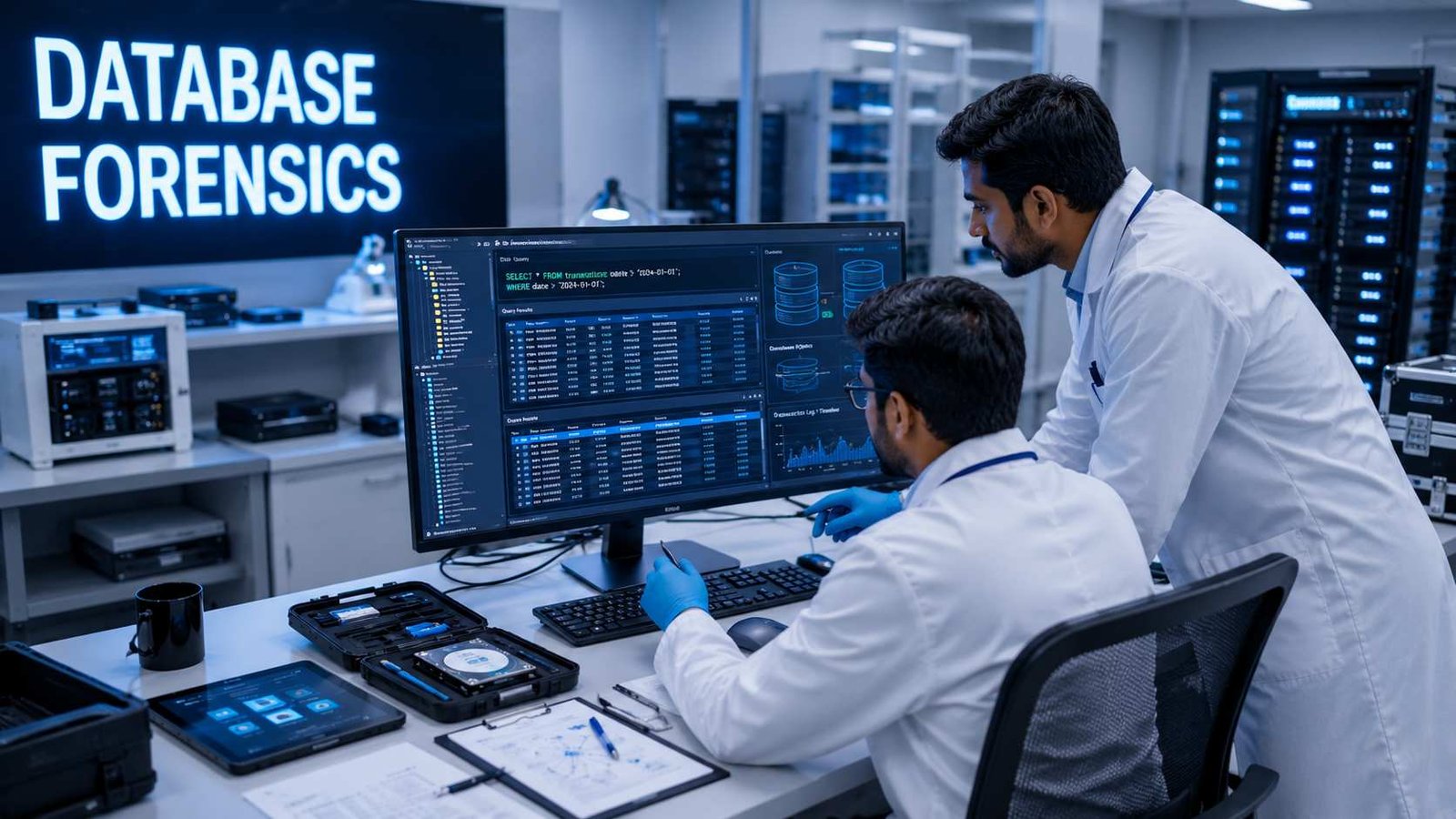
Finding the truth requires more than ordinary data recovery. Investigators need to determine who accessed the database, what changes were made, when the incident occurred and whether the evidence can support legal action.
This is where database forensics becomes essential.
Database forensics is a specialized field of digital forensics focused on collecting, preserving, analyzing and reporting evidence from database systems. It helps organizations investigate cyber attacks, financial fraud, insider threats, unauthorized access, ransomware incidents and accidental database damage.
A professional database forensic investigation does not only recover information. It reconstructs events, identifies suspicious activity and preserves digital evidence using accepted forensic procedures.
What is Database Forensics?
Database forensics is the scientific examination of databases, database files, transaction logs, metadata, audit records and related digital evidence to investigate security incidents and data-related crimes.
Unlike traditional database recovery, which focuses mainly on restoring lost information, database forensic analysis focuses on discovering the complete story behind an incident.
A database forensic investigation helps answer critical questions:
- Who accessed the database?
- Which user modified or deleted records?
- What information was changed?
- When did suspicious activity occur?
- How was the database compromised?
- Can deleted database records be recovered?
- Can the evidence be used during legal proceedings?
The primary objective is to recover evidence while maintaining data integrity, documentation and chain of custody.
Why Database Forensics is Important

Modern businesses operate on data. A database failure, cyber attack or unauthorized modification can result in financial losses, regulatory problems and reputational damage.
Organizations commonly rely on database platforms such as:
- MySQL
- Microsoft SQL Server
- Oracle Database
- PostgreSQL
- MariaDB
- MongoDB
- SQLite
- IBM DB2
- Azure SQL Database
- Amazon RDS
- Google Cloud SQL
A single security incident can expose thousands or even millions of sensitive records.
Professional database forensic analysis helps organizations:
- Detect cyber attacks
- Investigate database breaches
- Identify unauthorized users
- Recover deleted records
- Analyze transaction history
- Examine suspicious database activity
- Investigate employee misconduct
- Support legal investigations
- Maintain regulatory compliance
Without proper forensic investigation, important evidence may be overwritten, deleted or permanently lost.
Database Forensics vs Database Recovery
Database recovery and database forensics are closely related but serve different purposes.
Database Recovery | Database Forensics |
Restores lost or damaged data | Investigates database incidents |
Focuses on data availability | Focuses on evidence analysis |
Repairs corruption issues | Determines cause and timeline |
Retrieves inaccessible records | Identifies suspicious activities |
Supports business continuity | Supports investigations and legal cases |
In many real-world incidents, both services are required.
For example, when a database server suffers physical damage, experts may first perform professional server recovery before conducting forensic analysis on recovered database evidence.
Common Cases That Require Database Forensic Investigation
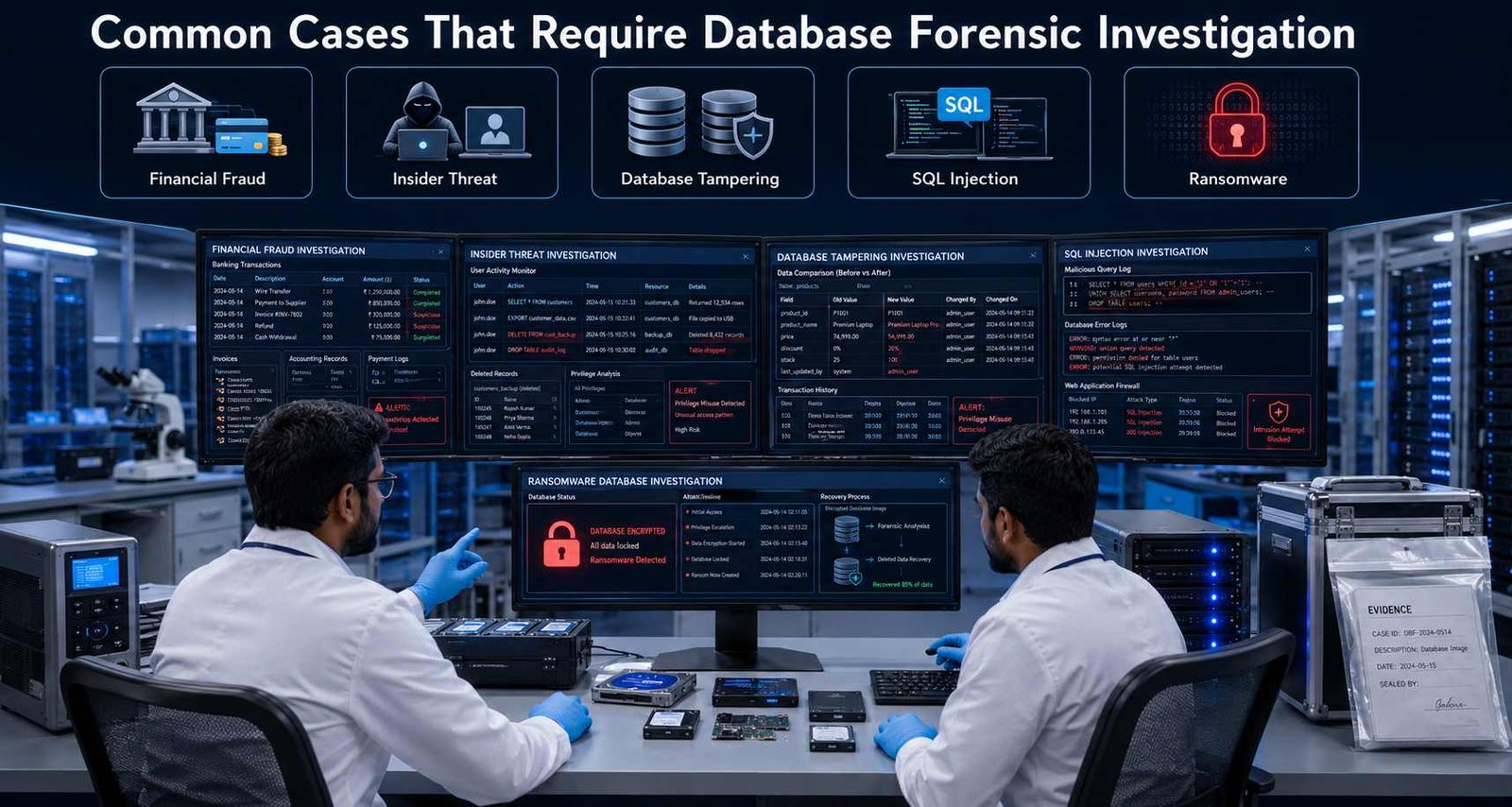
Database forensic experts investigate different types of incidents, including:
Financial Fraud Investigation
Financial institutions and businesses often require database forensic analysis when attackers or employees manipulate:
- Banking transactions
- Accounting records
- Payment information
- Invoice data
- Financial reports
Investigators analyze logs, user activity and database changes to identify unauthorized modifications.
Insider Threat Investigation
Employees with database access can sometimes misuse their privileges by:
- Deleting customer information
- Copying confidential records
- Changing business reports
- Accessing restricted information
Database forensics https://dataengineers.in/forensics/ helps identify user actions and establish accountability.
Database Tampering Investigation
Attackers may modify database information to:
- Change product prices
- Alter transaction history
- Manipulate customer records
- Modify business information
Forensic analysis helps detect unauthorized changes and trace the source.
SQL Injection Investigation
SQL injection attacks allow attackers to manipulate database queries and access confidential information.
Database forensic experts analyze:
- Suspicious queries
- Application logs
- Database transaction records
- User activity
- Access patterns
to determine the attack method and impact.
Ransomware Database Investigation
Ransomware attacks can encrypt or damage critical databases.
Database forensic investigation helps determine:
- Attack timeline
- Initial access method
- Data modification activity
- Deleted evidence
- Possible recovery options
How Database Forensic Investigation Works

A professional database forensic investigation follows a structured process to ensure evidence remains accurate and reliable.
Step 1: Evidence Preservation
The first step is protecting the original evidence.
Investigators avoid working directly on live databases because any modification can affect evidence integrity.
Instead, forensic copies or images are created for analysis.
This ensures:
- Original evidence remains unchanged
- Investigation findings remain reliable
- Chain of custody is maintained
Step 2: Database Acquisition
Database evidence may be collected from:
- Physical database servers
- Virtual machines
- Cloud environments
- Backup systems
- RAID storage
- NAS and SAN infrastructure
Organizations using enterprise storage may require specialized NAS & SAN data recovery https://dataengineers.in/services/nas-san-data-recovery/ before forensic examination begins.
Step 3: Database Metadata Analysis
Metadata provides valuable information about database activity.
Investigators analyze:
- Record creation timestamps
- Modification history
- Database permissions
- User accounts
- Object ownership
- Table relationships
- Database structure
Metadata analysis helps reconstruct events and identify suspicious behavior.
Step 4: Transaction Log Analysis
Transaction logs are among the most valuable sources of database evidence.
They can reveal:
- Deleted records
- Modified tables
- Unauthorized SQL queries
- Failed login attempts
- Data manipulation activity
- User operations
Transaction log analysis often helps investigators determine exactly what occurred during an incident.
Step 5: Timeline Reconstruction
After collecting and analyzing evidence, investigators create a detailed timeline.
The timeline may include:
- Initial unauthorized access
- User activities
- Database modifications
- Deleted information
- Security events
- Final database condition
This timeline helps organizations understand the complete incident sequence.
Advanced Database Forensic Techniques

Modern cyber incidents require more than simply reviewing database records. Advanced database forensic techniques help investigators uncover hidden activity, recover deleted evidence and identify the exact cause of a security incident.
Transaction Log Forensic Analysis
Transaction logs provide a historical record of database operations. These logs are extremely valuable because they can reveal activities even after records have been modified or deleted.
Investigators analyze transaction logs to identify:
- Deleted database records
- Unauthorized updates
- Modified transactions
- Suspicious SQL queries
- Failed authentication attempts
- Abnormal user behavior
- Data manipulation activities
Transaction log analysis is often one of the strongest sources of evidence during a database investigation.
Database Metadata Investigation
Metadata represents information about database objects and activities.
During forensic analysis, experts examine metadata such as:
- Record creation dates
- Last modification timestamps
- Database ownership
- User permissions
- Table structures
- Object identifiers
- File locations
- Database relationships
Metadata analysis helps investigators understand how the database was accessed and what changes occurred over time.
Database Audit Log Examination
Enterprise databases often maintain audit logs that record user activity.
Audit log analysis helps identify:
- Unauthorized access attempts
- Privilege abuse
- Administrator misuse
- Suspicious account activity
- Failed login attempts
- Unusual database operations
Audit logs are especially important in corporate fraud investigations and insider threat cases.
Deleted Database Record Recovery
Deleting information from a database does not always mean the evidence is permanently destroyed.
Professional database forensic https://dataengineers.in/forensics/ experts use specialized techniques to recover:
- Deleted tables
- Deleted rows
- Lost database pages
- Corrupted records
- Transaction log information
- Database fragments
The possibility of recovery depends on database condition, available logs, storage health and whether deleted information has been overwritten.
Database Breach Investigation
A database breach can expose sensitive customer, financial or business information.
Database breach investigations help determine:
- How attackers gained access
- Which information was affected
- What commands were executed
- Whether data was stolen
- How long attackers remained inside the system
A detailed forensic report helps organizations improve security and prevent future incidents.
Types of Databases Investigated
Professional database forensic investigations may involve various database technologies, including:
- MySQL
- Microsoft SQL Server
- Oracle Database
- PostgreSQL
- MariaDB
- MongoDB
- SQLite
- IBM DB2
- Microsoft Access
- Azure SQL Database
- Amazon RDS
- Google Cloud SQL
Each database platform stores evidence differently. Investigators require specialized knowledge of database architecture, storage formats and logging mechanisms.
Database Forensic Tools

Professional investigators use specialized forensic software and analysis tools to collect and examine digital evidence without modifying the original source.
Commonly used database forensic tools include:
- FTK Imager
- EnCase Forensic
- Autopsy
- Sleuth Kit
- Oracle LogMiner
- SQL Server Management Studio
- MySQL Binary Log Utilities
- Wireshark
- Volatility Framework
- Magnet AXIOM
The selection of forensic tools depends on:
- Database platform
- Operating system
- Storage environment
- Type of incident
- Investigation requirements
Challenges in Database Forensic Investigations
Database investigations have become increasingly complex because modern organizations use large-scale, distributed and encrypted environments.
Encrypted Databases
Encryption protects sensitive information but can create additional challenges during forensic examination.
Investigators may need to analyze:
- Encryption methods
- Access permissions
- Available keys
- Backup systems
- Related system logs
Cloud Database Forensics
Many organizations now use cloud database platforms.
Cloud investigations may involve:
- Amazon RDS
- Microsoft Azure SQL
- Google Cloud SQL
Cloud environments can be challenging because investigators may not have direct access to physical storage systems.
Large Database Volumes
Enterprise databases can contain millions or billions of records.
Handling such environments requires:
- Specialized forensic tools
- Advanced processing methods
- Secure evidence storage
- Efficient analysis workflows
Anti-Forensic Techniques
Cybercriminals may attempt to hide their activities by:
- Deleting logs
- Changing timestamps
- Removing audit records
- Encrypting databases
- Overwriting deleted information
Experienced forensic investigators analyze multiple evidence sources to identify these attempts.
Database Forensic Investigation Services in India
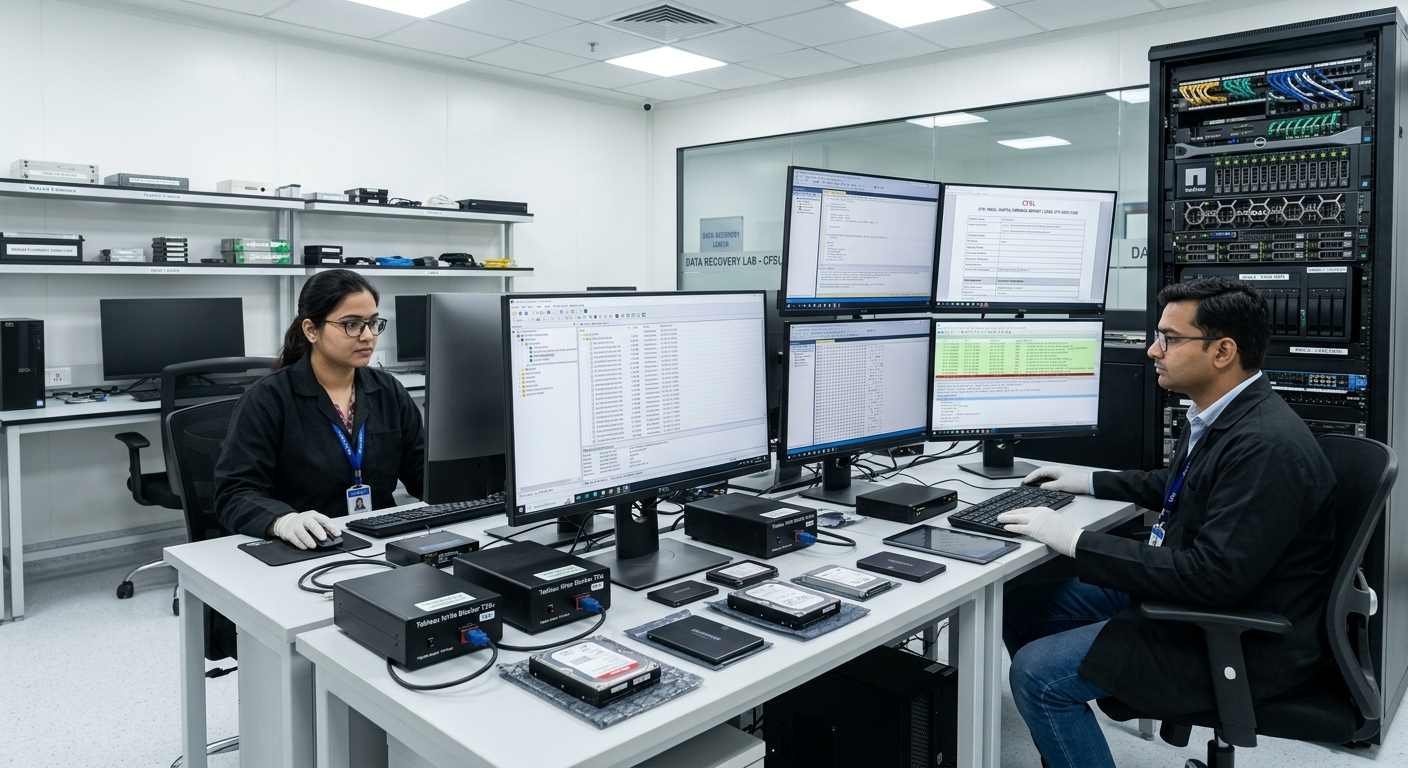
Organizations facing database incidents require experts who understand both digital evidence handling and data recovery processes.
Professional database forensic services help with:
- Database breach investigation
- Deleted database recovery
- SQL database analysis
- Transaction log examination
- Digital evidence preservation
- Insider threat investigations
- Cyber fraud investigations
- Database incident response
A reliable forensic investigation focuses on preserving evidence, maintaining confidentiality and delivering accurate findings.
Why Choose Data Engineers for Database Forensics?
When critical business information is involved, choosing an experienced forensic team is essential.
Data Engineers provides professional data recovery and digital forensic solutions for organizations dealing with database failures, storage damage and cyber incidents.
Our approach focuses on:
- Evidence preservation
- Secure handling procedures
- Data confidentiality
- Advanced recovery methodologies
- Detailed forensic reporting
Why Organizations Trust Data Engineers
- ISO-certified cleanroom facility
- ISO 9001 and ISO 27001 certified processes
- More than two decades of industry experience
- Thousands of successful recovery cases
- Confidential evidence handling
- Advanced storage recovery capabilities
- Professional technical support
- Nationwide assistance across India
Whether the issue involves damaged servers, RAID systems, SSD failures or inaccessible storage devices, our specialists can assist with secure recovery before forensic examination.
Related services:
- Hard disk data recovery
- SSD data recovery
- Server data recovery
- RAID recovery
- Damaged storage forensics
Best Practices for Database Forensic Investigation
Maintaining evidence integrity is the foundation of successful forensic analysis.

Professional investigators should:
- Never analyze original evidence directly
- Create forensic copies before examination
- Maintain proper chain of custody
- Document every investigative step
- Use verified forensic tools
- Generate cryptographic hashes
- Securely store evidence
- Prepare detailed forensic reports
Following these practices ensures evidence remains reliable and suitable for investigation purposes.
Industries That Require Database Forensics
Database forensic investigations are required across multiple industries.
Banking and Finance
Used for:
- Transaction fraud investigation
- Unauthorized payment analysis
- Financial record manipulation
Healthcare
Used for:
- Patient data access investigation
- Medical database protection
- Privacy compliance investigations
Government Organizations
Used for:
- Sensitive database investigations
- Unauthorized access detection
- Data integrity verification
Businesses and Enterprises
Used for:
- Employee misconduct investigations
- Customer database theft
- Intellectual property protection
Contact Data Engineers
Office Address
704, Meghdoot Building-94
Nehru Place, New Delhi
Phone
+91-981-856-7981
For professional assistance with database forensics, digital evidence preservation, RAID recovery, server recovery, SSD recovery or hard disk data recovery, contact Data Engineers https://dataengineers.in/forensics/ for expert guidance and confidential support.
Conclusion: The Importance of Database Forensics in Modern Cyber Investigations
As organizations continue to depend on digital information, database security incidents are becoming increasingly complex.
Data theft, ransomware attacks, insider threats, financial fraud and accidental deletion can create serious operational and legal challenges.
Database forensics helps organizations uncover the truth by analyzing digital evidence, reconstructing events and identifying unauthorized activities.
A successful investigation requires a combination of forensic expertise, secure evidence handling and advanced recovery capabilities.
Whether you are dealing with a database breach, deleted records, damaged storage systems or suspicious database activity, professional forensic assistance can help preserve evidence and recover critical information.
Data Engineers provides specialized support for database-related incidents, digital evidence preservation and advanced data recovery requirements with secure and professional investigation methods.

Worldwide Leader in Data Recovery

Leave a Comment