
- 18 September, 2026
- Data Engineers
- 0 Comments
- 9 Views
- Blog
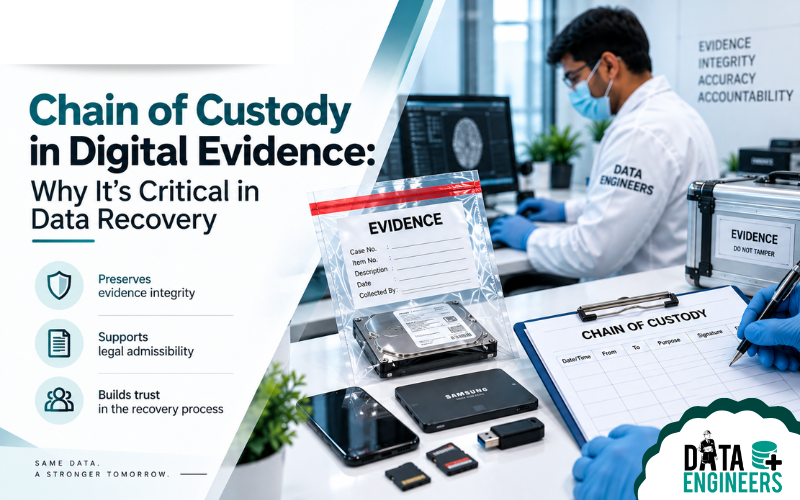
Chain of Custody in Digital Evidence: Why It’s Critical in Data Recovery
Digital evidence can be incredibly valuable—and incredibly easy to change.
A hard drive, SSD, smartphone, USB drive, server, CCTV system or other storage device may contain files that are important to an investigation, dispute, internal incident review or legal proceeding. But simply recovering those files is not always enough.
You also need to be able to explain:
- Where did the evidence come from?
- Who handled it?
When was it transferred? - What was done to it?
- Was the original evidence altered?
This is where the chain of custody in digital evidence becomes critical.
In digital forensics, chain of custody is the documented history of evidence from collection through preservation, transfer, examination, analysis, reporting and final disposition. NIST describes it as tracking the movement of evidence while documenting the people involved, dates/times and purpose of transfers.
For forensic data recovery, maintaining this record helps protect the integrity and credibility of recovered digital evidence.
What Is Chain of Custody in Digital Evidence?
Chain of custody is the documented record of how digital evidence was collected, preserved, transferred, examined, stored and ultimately returned or disposed of.
The purpose is to establish a reliable history of the evidence.
For example, imagine a company submits a hard drive for investigation.
A proper forensic process should be able to document information such as:
- What device was received
- Device make and model
- Serial number
- Condition when received
- Date and time of intake
- Who received the device
- Where the device was stored
- Who accessed it
- What forensic procedures were performed
- What image or copy was created
- Hash values associated with the evidence
- When evidence was transferred
- Who received it
- Where the recovered data was stored
- What was ultimately returned
NIST emphasizes that digital forensics involves identification, collection, examination and analysis while preserving information integrity and maintaining a strict chain of custody.
That documentation is what turns “we recovered these files” into a much more defensible forensic record of how those files were obtained and handled.
Why Is Chain of Custody Important?
Digital files are different from physical objects.
A physical document can be visibly inspected for changes. Digital information can potentially be copied, modified, deleted or altered without obvious physical signs.
That makes digital evidence preservation particularly important.
A strong chain-of-custody process helps answer questions such as:
Was the evidence changed?
Documentation, forensic imaging and integrity checks can help demonstrate whether the evidence remained consistent during examination.
Who had access to it?
A custody record can show who received, transferred, stored or examined the evidence.
When was it handled?
Dates and timestamps establish a chronological record.
What was done to the evidence?
The forensic record should explain examination, imaging, recovery and analysis activities.
Can another examiner understand the process?
Good forensic methodology should be documented well enough that another qualified examiner can understand what was performed and why.
NIST’s digital evidence preservation guidance specifically recommends documenting the original source and creation/transfer history of digital images and using hashes to help protect digital integrity.
Chain of Custody vs. Normal Data Recovery
This distinction is extremely important.
Standard Data Recovery
The primary objective is usually:
Recover the customer’s files.
A conventional recovery case may focus on:
- Deleted files
- Formatted drives
- Corrupted partitions
- Failed HDDs
- SSD failures
- RAID failures
- Lost folders
- Inaccessible storage
The priority is recovering usable data.
Forensic Data Recovery
The objective is broader:
Recover and preserve data in a manner that maintains its evidentiary integrity.
A forensic case may require:
- Evidence identification
- Controlled acquisition
- Write-blocking
- Forensic imaging
- Hash verification
- Chain-of-custody documentation
- Evidence preservation
- Metadata preservation
- Examination records
- Detailed forensic reporting
NIST’s definition of digital forensics includes chain of custody, mathematical validation, validated tools, repeatability, reporting and potentially expert testimony.
So if the recovered information may be used in an investigation or legal proceeding, forensic data recovery is not simply ordinary file recovery with a different name.
What Counts as Digital Evidence?
Almost any digital storage or computing system can potentially contain evidence.
Examples include:
Computers and Laptops
- Windows PCs
- Mac computers
- Linux systems
- Workstations
- Employee laptops
Storage Devices
- Hard disk drives
- SSDs
- External hard drives
- USB flash drives
- Memory cards
- Optical media
- Backup media
Mobile Devices
- Smartphones
- Tablets
- Damaged mobile devices
Business Infrastructure
- Servers
- RAID arrays
- NAS
- SAN
- Virtual machines
- Enterprise storage
Surveillance Systems
- CCTV DVRs
- NVRs
- Surveillance storage
Other Sources
- Cloud environments
- Email systems
- Network logs
- Application data
- Connected devices
Data Engineers currently provides digital forensics capabilities across areas including damaged RAID, smartphones, drones, CCTV and other forensic investigations.
How Chain of Custody Works in Digital Forensics
A practical chain of custody digital evidence workflow generally follows a controlled sequence.
1. Evidence Identification
The first step is identifying the device or digital source.
The examiner may document:
- Device type
- Make
- Model
- Serial number
- Capacity
- Physical condition
- Identifying labels
- Existing damage
The condition of the device should be recorded before examination.
2. Evidence Intake
The evidence is formally received and assigned an identification or case reference.
The intake record may include:
- Date and time
- Person delivering the evidence
- Person receiving it
- Device details
- Packaging condition
- Evidence identifiers
- Initial condition
This creates the starting point of the custody record.
3. Secure Evidence Storage
The original device should be stored in a controlled environment when it is not being examined.
The goal is to limit unauthorized access and unnecessary handling.
For sensitive cases, access should be restricted and documented.
4. Forensic Acquisition
Instead of casually browsing the original device, forensic practitioners may create a forensic image.
A forensic image is a bit-level representation of the relevant storage media or evidence source.
This allows examination to be performed on a working copy while preserving the original evidence.
5. Hash Verification
A cryptographic hash can be used as a digital fingerprint of data.
NIST recommends hashing digital images and other objects and storing the resulting hashes securely and separately from the image or file.
If the same data is hashed again and the expected value matches, the hash provides a mechanism for checking data integrity.
This is why hash values and digital evidence are such important parts of forensic workflows.
6. Examination and Analysis
Once the evidence has been safely acquired, investigators can examine the forensic copy.
Depending on the case, this may involve:
- Deleted file recovery
- File-system analysis
- Metadata examination
- Timeline analysis
- Email analysis
- User activity
- Browser artifacts
- Application data
- CCTV footage
- RAID reconstruction
- Malware-related artifacts
The original evidence should remain protected while examination takes place.
7. Documentation and Reporting
The final stage is not simply handing over a folder containing recovered files.
A forensic case may require a report explaining:
- Evidence received
- Acquisition method
- Tools or techniques used
- Hash values
- Examination performed
- Findings
- Recovered artifacts
- Limitations
- Evidence transfers
- Relevant timestamps
This documentation helps others understand how the evidence was handled and how conclusions were reached.
The Role of Hash Values in Digital Evidence
A hash value is often described as a digital fingerprint.
When a particular digital object is hashed using a specified algorithm, the resulting value can be recorded as part of the forensic documentation.
If the underlying data changes, the resulting hash will generally change as well.
This makes hashes useful for verifying whether a forensic image or digital record remains consistent.
NIST recommends the use of approved hashing approaches for digital evidence images and secure storage of the resulting hash information.
India’s current evidence framework is also relevant here.
The Bharatiya Sakshya Adhiniyam, 2023 recognizes electronic or digital records and contains specific provisions concerning electronic-record evidence. Section 63 addresses admissibility of electronic records and its Schedule includes fields for recording hash values and the algorithm used.
The exact evidentiary requirements can depend on the case and applicable law, so legal counsel should be consulted for case-specific advice.
Why Write-Blockers Matter
One of the biggest concerns during forensic acquisition is accidentally changing the original evidence.
A write-blocker is designed to prevent a storage device from being modified while it is being examined or imaged.
This is particularly important when the original storage device may later need to be presented as evidence.
The forensic objective is not simply:
“Can we open the drive?”
It is:
“Can we examine and recover the information while preserving the evidentiary state of the source?”
Current forensic recovery providers commonly identify hardware write-blockers, forensic imaging and documented custody as core components of evidence-preserving recovery.
What Happens During Forensic Data Recovery?
A forensic data recovery case may involve both data recovery and evidence preservation.
For example, suppose an employee’s HDD has failed and the company needs information from it for an internal investigation.
A forensic recovery workflow may look like this:
Device received → evidence documented → secure storage → controlled acquisition → forensic image → hash verification → examination → recovery → analysis → report → secure return
If the drive is physically damaged, the technical recovery process may become more complicated.
The examiner may need to address:
- Failed heads
- Damaged media
- Firmware problems
- Controller failures
- Bad sectors
- Partition corruption
- File-system damage
The important point is that physical recovery work and forensic evidence handling need to be coordinated.
For example, Data Engineers’ damaged RAID forensics service describes a workflow involving cloning, virtual reconstruction, file-system recovery and forensic handling, including preservation of metadata, chain of custody and write-blocking where appropriate.
What Can Break the Chain of Custody?
A chain of custody can become difficult to defend when important handling events are not properly documented.
Examples include:
Unrecorded Transfers
A device changes hands but the transfer is not documented.
Uncontrolled Access
Multiple people access the evidence without a clear record.
Direct Examination of Original Media
The original evidence is modified during investigation without appropriate controls.
Missing Hash Records
The relevant forensic image or digital object is created but integrity information is not properly recorded.
Poor Evidence Identification
Serial numbers, device details or evidence identifiers are missing.
Unclear Storage History
Nobody can establish where the evidence was stored between examination stages.
Incomplete Forensic Reporting
The final report does not adequately explain what was done.
The result is not necessarily that evidence automatically becomes unusable in every case. Rather, gaps in documentation can make authenticity, integrity and handling much harder to establish.
Recent Indian judicial decisions have specifically discussed the importance of chain-of-custody documentation and hash information in evaluating electronic evidence.
Chain of Custody and Legal Proceedings in India
For businesses, lawyers, investigators and organizations in India, digital evidence is increasingly relevant to legal and regulatory matters.
The Bharatiya Sakshya Adhiniyam, 2023 replaced the earlier Indian Evidence Act framework and contains provisions specifically dealing with electronic and digital records. Section 61 states that an electronic or digital record is not to be denied legal effect merely because it is electronic or digital, subject to the Act’s provisions; Sections 62 and 63 address proof and admissibility of electronic records.
The Schedule to Section 63(4) includes information about the source device and hash values, including the hashing algorithm used.
A May 2026 Supreme Court order discussing Section 63(4) also described the hash value as an electronic fingerprint and noted its role in verifying authenticity and integrity.
Recent Indian cases have further shown why continuity of custody, hash documentation and forensic records can matter when electronic evidence is challenged.
Important: forensic procedures and evidentiary requirements can vary by case, court and jurisdiction. A data recovery provider should not replace qualified legal advice.
When Do You Need Forensic Data Recovery?
Not every deleted file requires a forensic investigation.
Standard recovery may be enough when you simply need personal files recovered from:
- Accidentally formatted drives
- Deleted partitions
- Failed HDDs
- Damaged SSDs
- Corrupted storage
Forensic recovery becomes more relevant when the data may be used as evidence.
Examples include:
- Corporate investigations
- Employee misconduct investigations
- Litigation
- Cybercrime investigations
- Fraud investigations
- Intellectual-property disputes
- Internal security incidents
- Ransomware investigations
- Financial investigations
- Law-enforcement matters
- Insurance disputes
- Regulatory investigations
If the evidence needs to be preserved and documented from intake through examination, a normal “plug in the drive and recover files” approach may not be appropriate.
How to Choose a Digital Forensics and Recovery Provider
When selecting a provider for a sensitive forensic case, don’t focus only on whether they can recover files.
Ask about the process.
1. Do They Maintain Chain-of-Custody Records?
The provider should be able to explain how evidence transfers and access are documented.
2. Do They Use Forensic Imaging?
Ask whether examination is performed from a forensic image where appropriate.
3. How Is Evidence Protected?
Controlled access, secure storage and appropriate evidence handling should be part of the workflow.
4. Are Hash Values Recorded?
Hashing can support integrity verification and should be incorporated appropriately into the forensic process.
5. Are Write-Blocking Procedures Available?
Forensic cases may require preventing writes to original media.
6. Is a Detailed Report Provided?
The final documentation should explain the examination process and findings clearly.
7. Can the Provider Handle Physical Recovery?
A forensic case involving a failed HDD or damaged RAID may require both data recovery expertise and forensic evidence handling.
Data Engineers provides digital forensics services in India, including damaged RAID forensics and other specialized forensic investigations.
For damaged RAID evidence, see damaged RAID forensics.
For conventional storage failures, hard disk data recovery and SSD data recovery may be more appropriate.
Conclusion
Digital evidence can be fragile, even when the storage device itself looks completely normal.
A hard drive may contain emails, documents, photographs, databases, CCTV recordings or other information that becomes important during an investigation. Recovering those files is only part of the job.
The other part is being able to explain:
- Where did the evidence come from?
- Who handled it?
- How was it preserved?
- Was the original media protected?
- How was the forensic copy created?
- Were hash values recorded?
- What examination was performed?
- Can the entire process be documented?
That is why the chain of custody in digital evidence is so important.
For ordinary personal data recovery, the priority may simply be getting files back.
For forensic data recovery, the priority is broader:
Recover the data. Preserve its integrity. Document the process. Protect the evidence.
If your organization is dealing with a damaged HDD, SSD, RAID system, server, mobile device or other storage medium that may contain evidence, avoid experimenting with the original device.
Data Engineers provides digital forensics services and specialized damaged RAID forensics, alongside professional hard disk data recovery and SSD data recovery services.
When data may become evidence, recovery should be handled with forensic discipline—not ordinary troubleshooting.
Frequently Asked Questions (FAQs)
What is chain of custody in digital evidence?
Chain of custody is the documented history of how digital evidence is collected, stored, transferred, examined and ultimately disposed of or returned. It records important details such as who handled the evidence, when it was transferred and why.
Why is chain of custody important in digital forensics?
It helps demonstrate that evidence was handled in a controlled and traceable manner. This supports confidence in the evidence’s integrity and helps investigators explain how the evidence moved from collection to examination.
What is forensic data recovery?
Forensic data recovery combines data-recovery techniques with evidence-preservation and documentation procedures. The goal is not only to recover information but also to preserve its evidentiary value where the case requires it.
What is a forensic image?
A forensic image is a controlled copy of digital storage or evidence created for examination. It allows analysis to be performed without unnecessarily altering the original source.
Why are hash values important in digital evidence?
Hash values can act as digital fingerprints for a data object or forensic image. Recording and comparing hashes can help verify that the examined data remains consistent.
What is a write-blocker?
A write-blocker is a hardware or software control designed to prevent modifications to a storage device while it is being examined or acquired for forensic purposes.
Is chain of custody required for every data recovery case?
No. A normal personal data-recovery case may not require a formal forensic chain of custody. It becomes particularly important when the recovered information may be used as digital evidence in an investigation, dispute, regulatory matter or legal proceeding.

Worldwide Leader in Data Recovery

Professional Expertise with Long Term Experience
DATA ENGINEERS
011-26426316 | +91-9910132719 | +91-9818567981
support@dataengineers.in
Call us for a free advice.
Specialists at retrieving data from all types of hard drive and phone storage media, today Data Engineers has grown into the India’s largest and most technically capable data recovery company.




Leave a Comment